

Secure Assurance · Part of the Secure Advisory family
Secure Assurance: Vulnerability Remediation Management for Growing and Mid-Market Organizations
Findings arriving faster than anyone can close them? We keep one register, give every material finding an owner and a definition of “done,” check the evidence, and report progress in plain terms. Your team and providers do the fixes; we make sure they’re done and provable. For organizations from startups to about 5,000 employees.
When We Get the Call
The same findings reappear every test, lists live in five places, “done” just means a closed ticket, risk acceptances aren’t written down, and leadership can’t tell whether you’re improving.
The gap
Closing Is the Hard Part
Verizon’s 2026 DBIR found vulnerability exploitation was the top way into breached organizations, with a 43-day median time to fully patch (SecurityWeek summary).
The problem
No One Owns the Whole List
Work is split across an MSP, IT, an MDR, and vendors. Meanwhile insurers, auditors, and customers increasingly ask for proof that fixes were made.
What it is
One Register, Every Source, Proven Closed
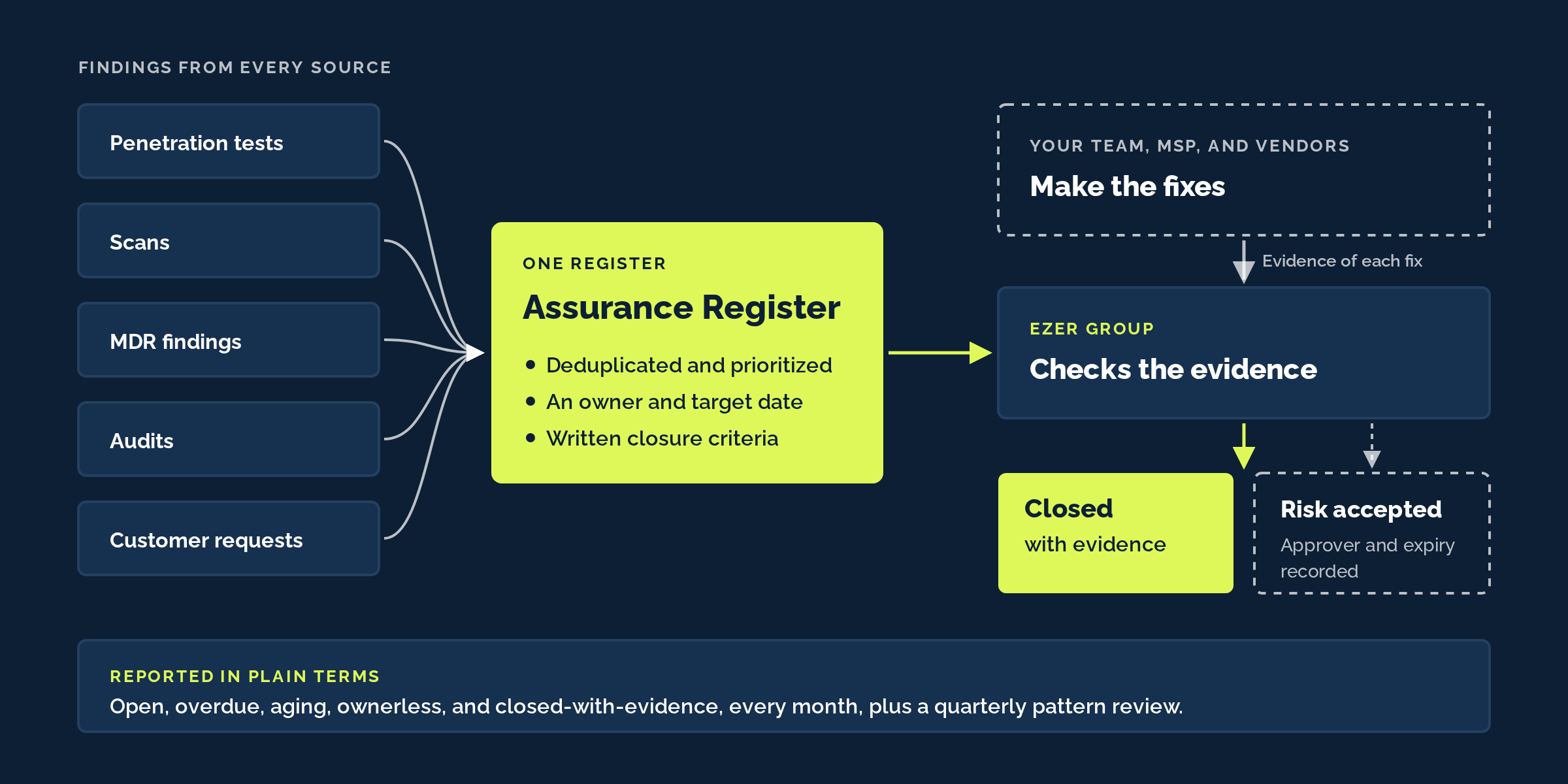
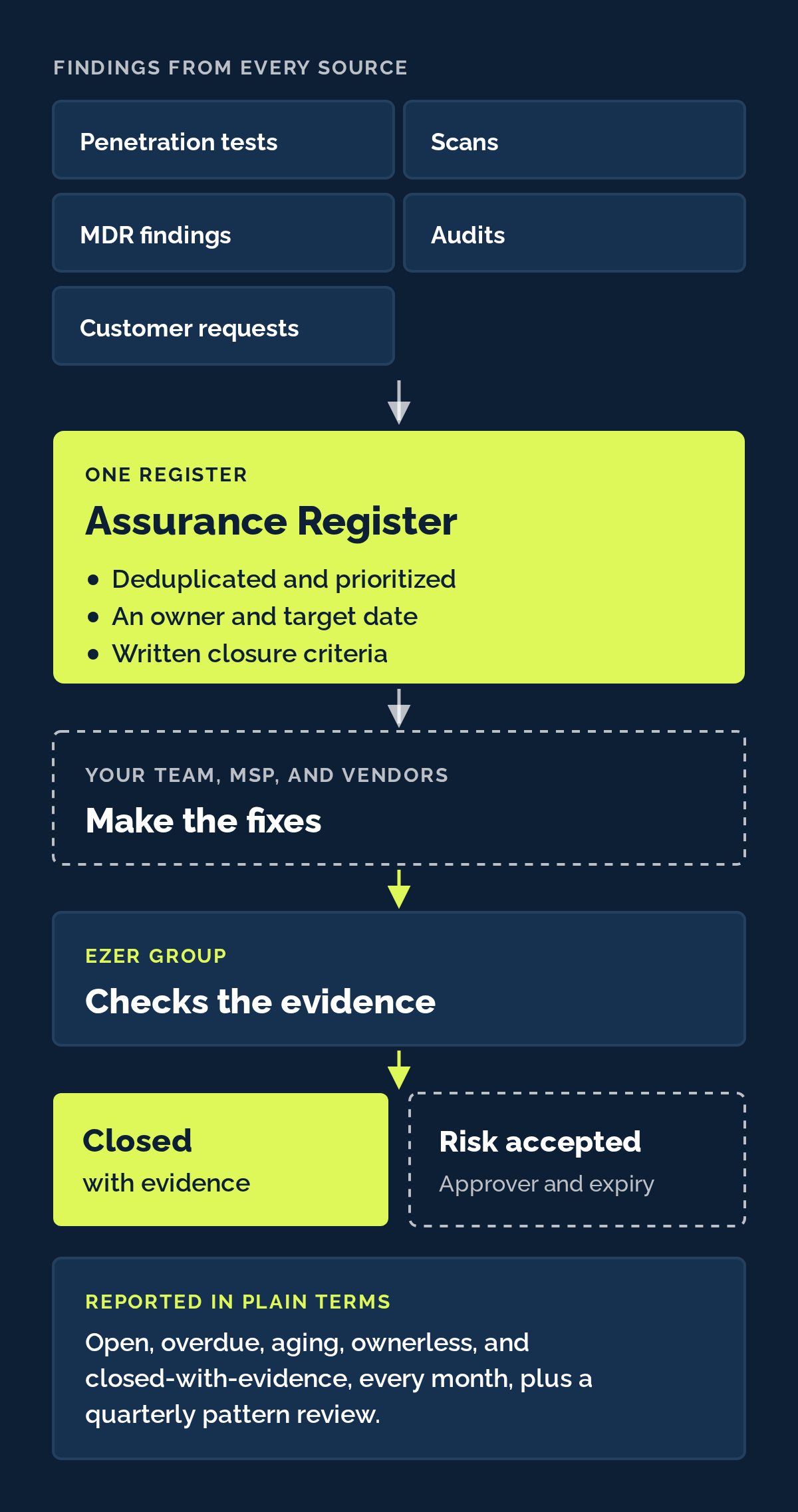
Findings from tests, scans, MDR, audits, and customers go into one register. Every material finding gets an owner, a target date, and written closure criteria. Your team and providers do the fixes; we check the evidence and report progress in plain terms.
Our approach
Trust then Tech
First we agree priorities and ownership for remediation. Then the fixes, made by your team and providers, managed and verified by Ezer.
Fit
Who It’s For
Organizations with recurring findings from tests, scans, MDR, audits, or customers; remediation split across teams; and a need to prove closure, including under frameworks like CMMC, PCI DSS, or SOC 2. Industry-agnostic.
What It Is, and Isn’t
| Secure Assurance is | Secure Assurance isn’t |
|---|---|
| Governance of findings to evidence-backed closure | A 24x7 SOC or incident response service |
| Evidence review and closure recommendations | A certification or formal retest |
| Coordination of your team, MSP, MDR, and vendors | Hands-on remediation |
| Support for documented risk-acceptance decisions | Accepting risk on your behalf |
| A system of record in your tools, or a register we set up for you | Another scanning tool |
How it works
Seven Steps to Proven Closure
| Step | What happens |
|---|---|
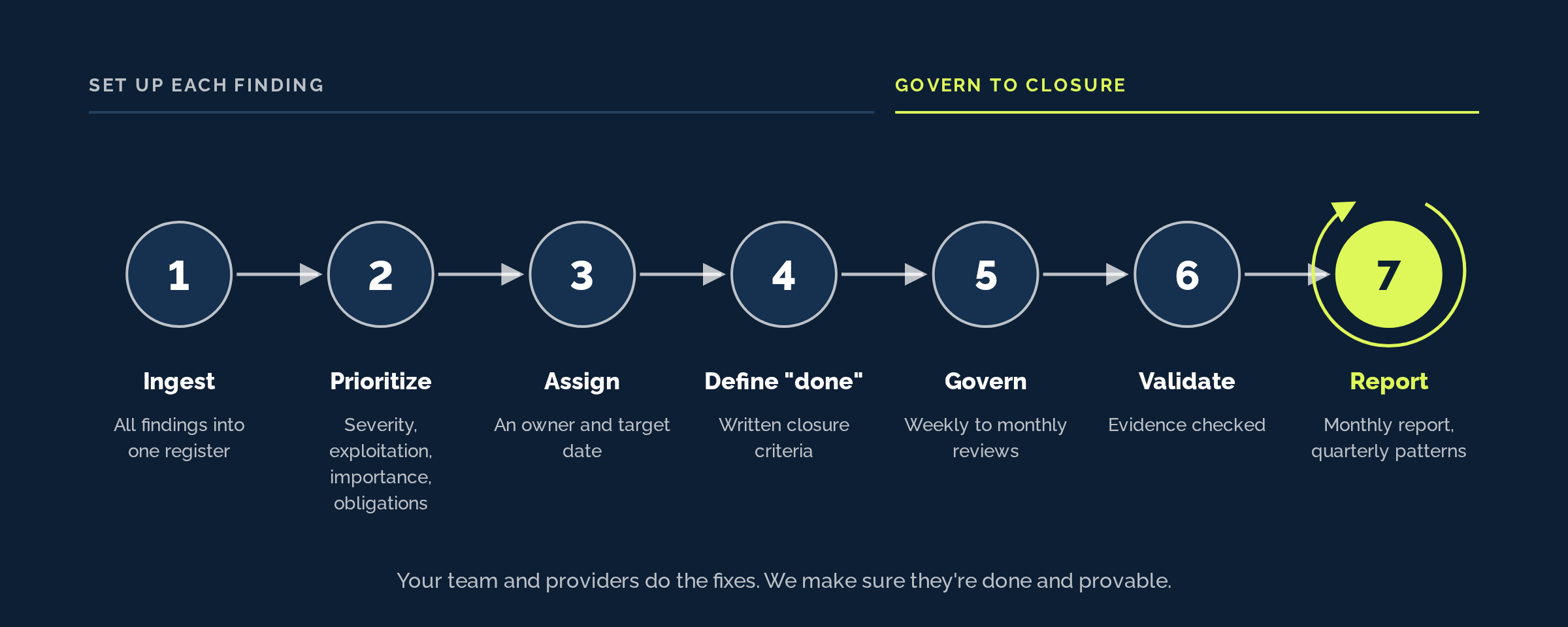
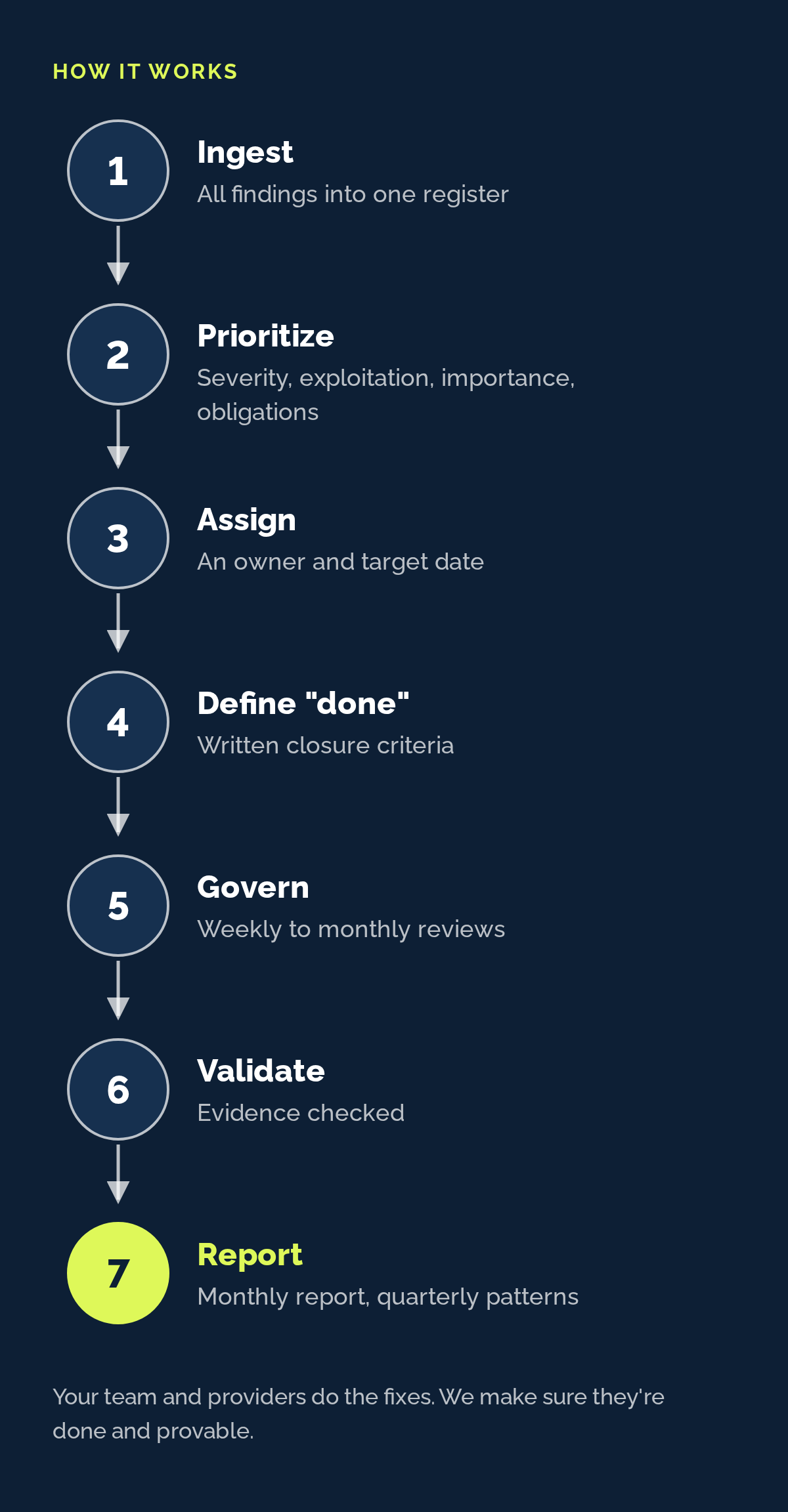
| 1. Ingest | All findings into one register, deduplicated and normalized |
| 2. Prioritize | By severity, exploitation, system importance, and obligations |
| 3. Assign | An accountable owner and target date for each |
| 4. Define “done” | Written closure criteria |
| 5. Govern | Weekly to monthly reviews; escalations and risk acceptances recorded |
| 6. Validate | Evidence checked; closure, rescan, or formal retest recommended |
| 7. Report | Monthly executive report and quarterly pattern review |
You own the register
What You Get
| Deliverable | Purpose |
|---|---|
| Assurance Register | One authoritative list, in your GRC or ticketing tool or a register in your workspace |
| Owners, dates, closure criteria | For every material finding |
| Review notes and action lists | After every governance review |
| Validation notes | Closure recommendations with evidence |
| Risk-acceptance log | Approvers and expiry dates |
| Monthly executive report | Open, overdue, aging, ownerless, closed-with-evidence |
| Quarterly pattern review | Root-cause recommendations |
The register is yours. If the engagement ends, we hand it over with the latest reports.
Engagement Options

Recommended start
90-Day Assurance Sprint
Taking one pentest’s or audit’s findings to evidence-backed closure.

Ongoing
Ongoing: Essentials
Monthly reviews, one or two finding sources.
Ongoing
Ongoing: Core
Biweekly reviews, most mid-market organizations.
Ongoing
Ongoing: Expanded
Weekly reviews, multiple providers or entities.

Module
Secure Advisory module
Run by your existing Advisory Lead.
Scoped after your strategy session by finding volume and cadence.
Who Does What
We manage the work and verify it. We don’t replace your providers.
| Activity | Ezer Group | Your team, MSP, and vendors |
|---|---|---|
| Register | Keeps one register, in your tools or a register we set up for you | Work from the same list |
| Prioritize and assign | Prioritizes findings and sets an owner, target date, and closure criteria for each | Owners take on their findings |
| Fixes | Tracks every finding to closure and escalates when it’s needed | Make the fixes |
| Validation | Reviews evidence against closure criteria and recommends closure, rescan, or formal retest | The original tester or auditor keeps the formal retest |
| Risk acceptance | Supports documented risk-acceptance decisions | Your approvers decide, with expiry dates recorded |
| Reporting | Monthly executive report and quarterly pattern review | Leadership sees progress in plain terms |
How it connects
How It Fits With Our Other Services
Secure Assurance is part of the Secure Advisory family. Findings from our other services, and material MDR findings that need more, route here so each is tracked once.
PLAN AND GOVERN · SECURE ADVISORY FAMILY

Secure Comply
Controls and audit evidence.
Comply governs controls and audit evidence; Assurance governs technical findings. Each is tracked once.
Secure Assurance
You are here.
Remediation managed and verified, so findings actually get closed.
ASSESS AND TEST

Secure Ready
A starting register.
Its findings register can become your starting register.

Secure Complete
Findings flow in.
Its findings flow in. The 90-day retest comes only with the Annual Penetration Testing Program.
CHOOSE A PARTNER

Secure Match
A neutral comparison.
Neutral selection of the right MSP, MSSP, or MDR provider.

The foundation
Ezer Group AI MDR Powered by Cyrebro
AI speed, human judgment, 24x7 + Secure Navigator
A 24x7 human-powered SOC on the Cyrebro MDR platform, plus Secure Navigator: one accountable Ezer lead who routes material findings to closure.
Always watching.
Everything else builds on it.
MDR follows through on material MDR findings; Assurance extends that to every other source, without duplicate work.
Our own service, disclosed up front. Prefer an independent comparison? Use Secure Match.
Transparency
Vendor-Neutral by Design
Reviewers aren’t the people who made the fix. Same compensation whichever provider you choose. Ezer Group AI MDR is our own service, and we say so up front whenever it’s an option. For an independent provider comparison, see Secure Match.
Why Ezer Group
Proof, not progress
Closure means evidence checked against written criteria.
Works with your providers
We coordinate them; we don’t replace them.
Independent review
Reviewers aren’t the people who made the fix. Same compensation whichever provider you choose.
Practitioners
Leaders who’ve built SOCs, MSSP practices, and compliance service lines. About Ezer Group. Serving clients nationwide.
Frequently Asked Questions
What is vulnerability remediation management?
Making sure findings actually get fixed: one list, an owner and deadline for each, a definition of “done,” regular follow-up, and evidence each fix worked. Scanners find vulnerabilities; remediation management gets them closed.
Doesn’t our MDR provider already do this?
MDR providers detect and respond to threats. They usually don’t own the backlog from pentests, scanners, and audits or verify fixes made by other teams. Secure Assurance fills that gap alongside your MDR, including Ezer Group AI MDR.
We use the Secure Complete platform. Do we need this?
Not always. The platform tracks its own findings, but bought alone it doesn’t include Ezer validation of findings (you still get an engagement manager and the quarterly Exposure Review). Secure Assurance adds every other source, cross-team owners, closure criteria, evidence review, escalation, and documented risk acceptance.
Do you fix the findings?
Not as part of Secure Assurance. Your team, MSP, and vendors make the fixes; we manage the work, track every finding to closure, and verify each fix with evidence.
What does “evidence-backed closure” mean?
We review evidence against each finding’s closure criteria and recommend closure. For pentest or audit findings, the original tester or auditor keeps the formal retest. The Secure Complete Annual Penetration Testing Program includes a 90-day retest; other retests are scoped separately.
Can you work in our existing tools?
Yes: your GRC platform, ticketing system, or spreadsheet, or a register we set up in your shared workspace.
How is this different from a vCISO?
A vCISO leads your whole program. Secure Assurance focuses on getting findings closed and proven closed, with a path to full Secure Advisory.
Does this help with CMMC or PCI DSS?
It helps you meet and document remediation deadlines, such as closing CMMC POA&M items within 180 days of conditional status. It doesn’t replace your assessor. Framework readiness is available through Secure Comply.
Does this help with cyber insurance?
It gives you a dated record of owners, deadlines, and completion evidence. It isn’t legal or coverage advice and doesn’t change your insurer’s decision.
How do we get started?
Book a 30-minute Cyber Strategy Session. If it’s a fit, we scope the work and recommend a Sprint or an ongoing tier.
Turn Findings Into Proven Fixes
Talk through where your findings come from and what you need to prove.